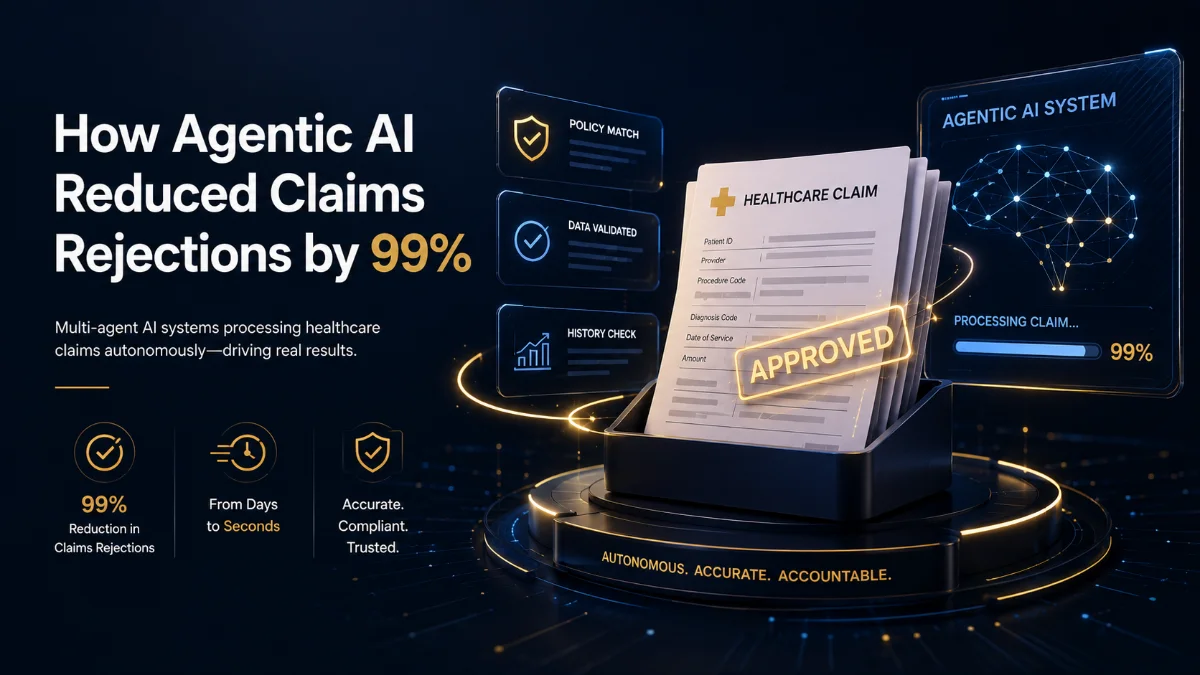
- Agentic AI uses multiple coordinated agents to run a multi-step process end to end, not a single prompt-and-response.
- On a healthcare programme, a multi-agent system cut claims rejections by 99% on live volume.
- The hard part is rarely the model — it is architecture, data grounding, escalation design and the discipline to reach production.
- Production means integrated, governed, adopted, and demonstrably moving the agreed metric.
"Agentic AI" is used loosely enough that it has started to lose meaning. So here is a concrete example of what it looks like in production, on a real healthcare programme: a multi-agent system that reduced claims rejections by 99% — not in a demonstration, but on live operational volume. The story is useful precisely because the lesson is not about a clever model. It is about the engineering and discipline that take AI from a promising pilot to a system the business can trust.
The problem
Claims were being rejected for avoidable reasons: missing fields, validation errors, mismatches against policy that were caught far too late in the process. Each rejection triggered rework, delay, and cost, and frustrated everyone in the chain. Worst of all, the volume scaled with the business — growth made the problem bigger, not smaller. Traditional rules engines caught the patterns they already knew about and missed everything else.
Why a single model was not enough
The instinct is to throw one large model at the problem and ask it to "fix claims." That fails, because a claim is not a single decision — it is a sequence of them: extract the data, validate it against policy, check it against historical context, resolve the routine cases, and escalate the genuine exceptions to a human. A single prompt-and-response cannot hold that process together reliably.
The model is rarely the hard part. Architecture, data grounding, escalation design and the discipline to keep going until the metric moves — that is where agentic AI is won or lost.
The agentic approach
Instead of one model, the system used multiple coordinated agents working the process end to end:
- Extraction and validation. Agents read each claim and checked it against policy and reference data before it ever reached a human.
- Autonomous resolution. The routine path — the large majority of claims — was resolved automatically, in seconds rather than days.
- Human-in-the-loop, by design. Genuine exceptions were escalated to people, with the context they needed to decide quickly — and nothing that did not need a human was sent to one.
- Grounding in real data. Outputs were grounded in the organisation’s own policies and history, so decisions were accurate and defensible rather than plausible guesses.
What "production" actually requires
The reason most AI dies between pilot and production is that teams underestimate everything around the model. To reach a 99% reduction on live volume, the system had to be integrated with core systems, governed with audit trails and oversight, adopted by the people whose work it changed, and measured against the metric agreed at the very start. That is the real definition of production: integrated, governed, adopted, and moving the number.
The result, and the lesson
A 99% reduction in rejections, resolution times cut from days to seconds, and — crucially — a system the business trusted because oversight was built into it from the beginning. The transferable lesson is not "use more AI." It is that production results come from treating the model as one component in a well-architected, well-governed, well-adopted system. Get the surrounding engineering right and the outcomes follow; get it wrong and the cleverest model in the world stays stuck in the lab.
This is the approach I bring to Agentic AI and GenAI builds — designing the architecture, grounding it in your data, and staying accountable through to adoption and measured impact.