- Long AI strategy documents impress in the room and then get ignored — length is a symptom of unfinished thinking.
- A strategy executives can hold in their head gets acted on; the depth belongs in the roadmap and operating model, not the page count.
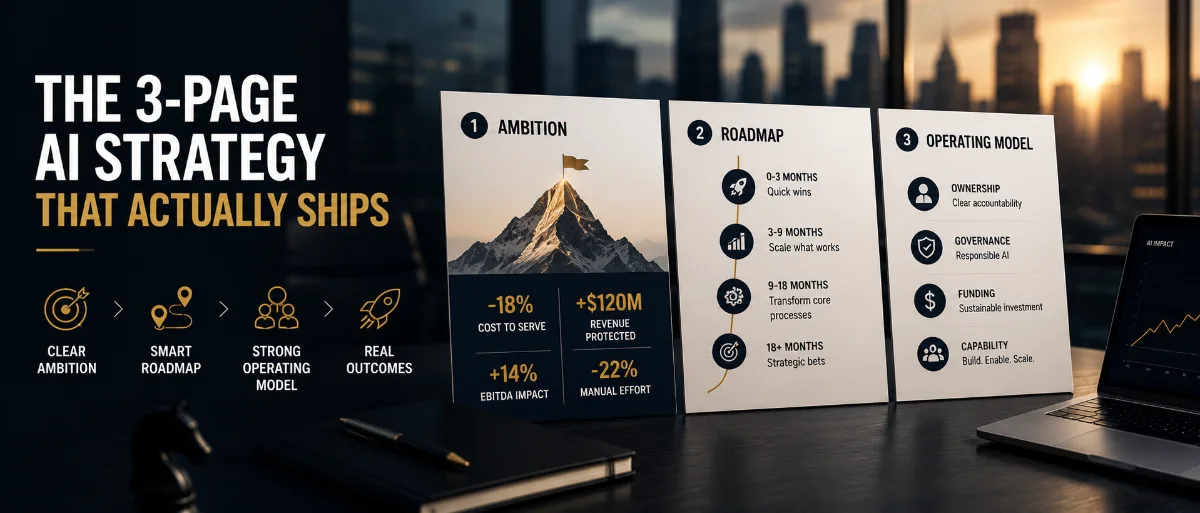
- The three pages are: the ambition (in P&L terms), the sequenced roadmap, and the operating model.
- This format is what got an $80M programme approved in a single board meeting.
I have seen eighty-page AI strategies that shipped absolutely nothing. They impressed in the room, earned a round of nods, and then sat on a shared drive while the organisation carried on exactly as before. Strategy only matters if it changes what happens on Monday morning. After fifteen years turning AI ambition into production results, I have learned that the strategy documents that actually ship are short — three pages — and that brevity is a feature, not a compromise.
Why long strategies fail
Length is usually a symptom of unfinished thinking. When a strategy runs to dozens of slides, it is often because the author has not yet decided what matters most, so everything is included as insurance. The reader cannot hold it in their head, cannot prioritise from it, and cannot be held accountable to it. A document that says everything commits to nothing.
There is also a political failure mode. A long, impressive deck is easy to applaud and easy to shelve, because approving it commits no one to a specific, measurable action. Ambiguity feels safe in the room and is fatal afterwards.
A strategy executives can hold in their head gets acted on. An eighty-slide deck gets admired and ignored.
The three pages
The depth still exists — it simply lives in the roadmap and the operating model, not in the document leadership is asked to approve. Here is what each page contains.
Page one — the ambition
Where AI must move the business, expressed in numbers leadership already cares about: cost, revenue, margin, risk, cost-to-serve. Not "we will be AI-first" but "we will cut cost-to-serve by X% and protect Y in at-risk revenue." The ambition page makes the case for why this matters in the only language the board scores by.
Page two — the roadmap
A sequenced set of initiatives, front-loaded with provable early wins that fund and de-risk the harder bets behind them. Each initiative names the outcome it drives, roughly when, and what it depends on. The sequence is the strategy: it shows momentum building rather than a flat list of everything that could be done.
Page three — the operating model
Who owns it, how it is governed, how it is funded, and what capability is required to deliver. This is the page most strategies skip, and it is the reason most strategies stall: a brilliant roadmap with no owner and no funding model is a wish list. Defining the operating model alongside the roadmap is what lets delivery start the day after approval.
Why brevity gets a "yes"
Brevity forces clarity, and clarity is what gets a board to commit. When a leadership team can read the whole thing in ten minutes, debate it, and see exactly what they are approving and what it will return, the decision becomes easy to make. This is the format behind an $80M programme I saw approved in a single meeting — not because the underlying work was simpler, but because the decision was made simple.
How to write yours
- Start from the P&L, not the technology — every initiative must trace to a number leadership already tracks.
- Sequence for momentum: put the credible, fast wins first so they fund the rest.
- Name an owner and a funding model on the same page as the roadmap.
- If a sentence does not change a decision, cut it. The depth lives in the appendix and the delivery plan, not the strategy.
If your AI ambition keeps stalling somewhere between the slide and the system, the problem is usually not the idea — it is the format. A strategy built to be delivered looks very different from one built to impress.